

📝 Disclaimer: The content on this site is for informational and educational purposes only and does not constitute professional advice. Always practice proper safety measures when camping and using outdoor gear.
* This post may contain affiliate links. As an Amazon Associate, we earn from qualifying purchases at no extra cost to you.
* This site uses AI technology for content assistance and illustrative imagery. Images are for demonstration purposes and do not depict real people or events.
Meaning of a Tarp Shelter
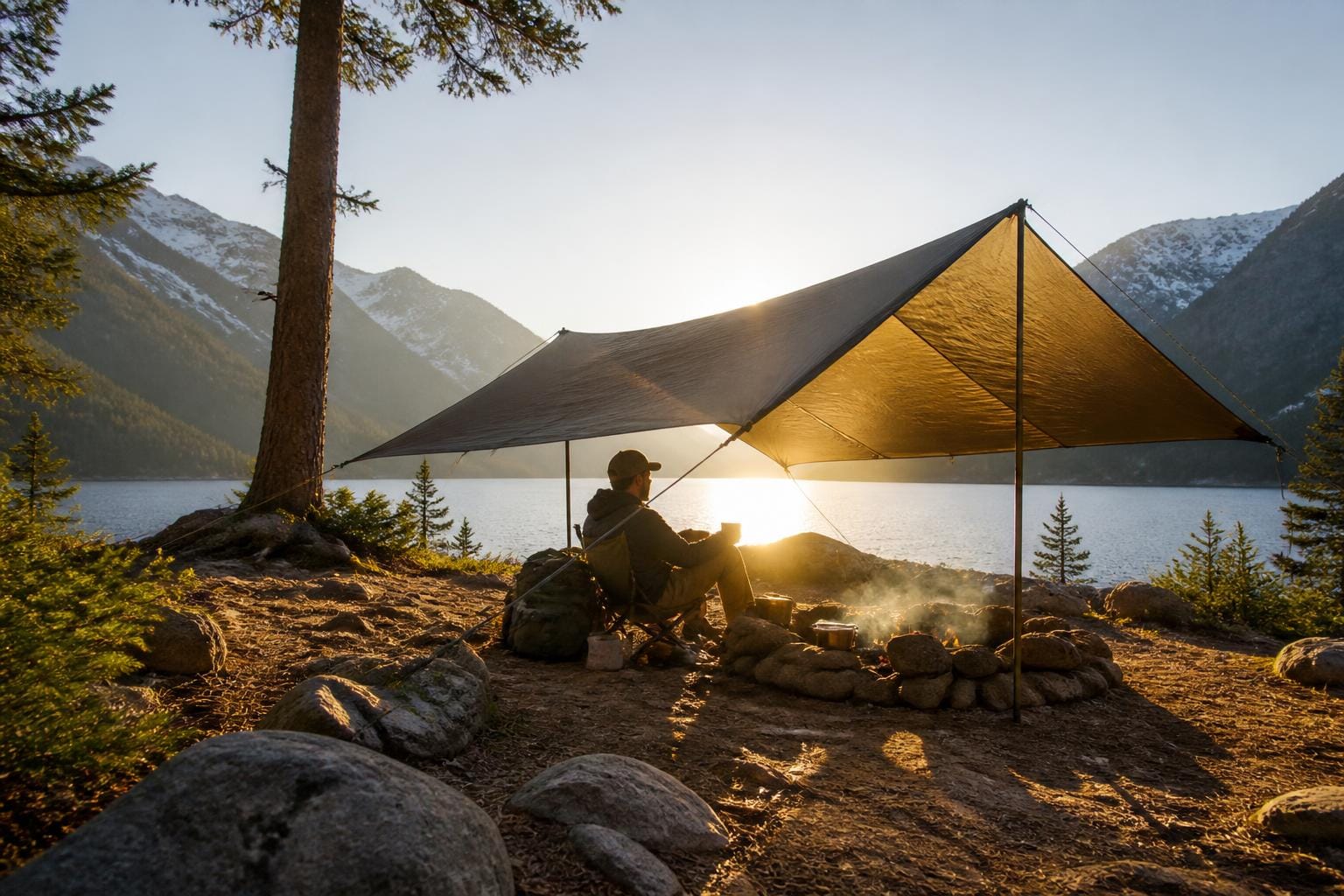
A camping tarp shelter is a temporary outdoor covering made from a broad sheet of fabric or coated material. It creates a partial overhead barrier from sun, light rain, or wind movement while remaining more open than an enclosed tent.
The phrase can describe several arrangements, including a simple canopy, an angled lean-to form, or a roof-like covering over a shared campsite area. Its meaning depends on the shape, supporting points, surrounding terrain, and intended use within the outdoor setting.
Structure and Materials
Tarp shelter structures commonly include a flexible sheet, reinforced corners, edge loops, seams, and attachment points. Materials vary from woven fabric to coated synthetic textiles, with differences in texture, weight, surface finish, and resistance to moisture.
Unlike a rigid shelter, a tarp has a changeable outline. Its appearance can shift with the angle of the fabric, the position of the supporting points, and the movement of air. The open sides create a visual connection with the landscape, while the overhead surface gives a campsite a defined center.
The word “structure” refers less to a permanent framework and more to the relationship between the covering, its supports, and the space beneath it. This makes tarp shelter terminology useful in descriptions of campsite layout and outdoor design.
Role in Campsite Layout
A tarp shelter often marks a communal zone for sitting, resting, preparing meals, or storing visible campsite items. It can create a transition between open ground and enclosed sleeping spaces without forming a fully sealed room.
In woodland settings, the covering may blend with surrounding shade and tree patterns. At a beach, meadow, or open field, its shape can appear more prominent against the horizon. The same shelter vocabulary can therefore describe both the item itself and its visual relationship with the landscape.
The area beneath a tarp is usually understood as a flexible, shared part of camp rather than a dedicated sleeping compartment. Furniture, containers, dishware, and other objects may be arranged beneath it according to the character of the campsite.
Weather, Light, and Visibility
Weather conditions strongly influence how a tarp shelter is perceived. Rain can make the surface appear taut or reflective, while sunlight may create changing patches of shade along the ground. Wind can produce movement in the fabric and alter the sound of the campsite.
Visibility also varies with the shelter’s height, angle, color, and surrounding vegetation. An open-sided canopy preserves broad views, whereas a lower or more angled arrangement creates a stronger sense of enclosure. At dusk, the covering can become a recognizable silhouette against the sky.
These observations belong to outdoor condition vocabulary rather than a fixed shelter formula. The structure remains a temporary environmental feature shaped by weather, terrain, and campsite activity.
Common Terms Associated With Tarp Shelters
- Canopy: A broad overhead covering that creates shade or a sheltered shared area without fully enclosing the sides.
- Ridgeline: A raised line or upper edge associated with an angled tarp form, giving the fabric a roof-like profile.
- Guy point: A reinforced location or attachment area on the tarp, discussed as part of its external shape and support layout.
- Reinforced corner: A strengthened section where fabric layers and attachment features meet.
- Open-sided shelter: A covering with visible gaps around the edges, preserving airflow and views of the campsite.
- Lean-to form: An asymmetrical arrangement with one sloping surface and a more defined sheltered side.
- Water-shedding surface: A descriptive term for fabric shaped so rain tends to move across its outer surface rather than collect in broad flat areas.
- Campsite commons: The shared activity space beneath or near a shelter, often associated with seating, meals, conversation, and general outdoor social life.
Outdoor Culture and Atmosphere
Tarp shelters are associated with adaptable campsite layouts, communal outdoor living, and a visual style that sits between a tent and an open picnic covering. They appear in family camps, group sites, minimalist travel settings, and recreational gatherings.
Their appeal within camping culture often comes from the balance between protection and openness. The structure frames views, gathers people beneath one surface, and makes weather changes visible rather than completely separating occupants from the surroundings. As a result, tarp shelter language describes both a material arrangement and a recognizable part of campsite atmosphere.